
Visit SEOalso known as natural search engine optimization, is now a the cornerstone of any successful digital strategy. Faced with ever-increasing competition from search engines, companies must redouble our efforts to appear in top positions in Google. To achieve this, we need to focus on three main areas: the quality of the contentstrategy, the linking (with quality backlinks) and technical optimization.
If netlinking allows you toincrease site authoritybut the targeted pages must be relevant, well-constructed and aligned with user expectations. Good content is the indispensable foundation on which all other SEO actions are built. Without it, even backlink campaigns the most powerful risk efficiency. With this in mind semantic optimization is particularly important to ensure a good and lasting positioning in the search results.
Against this demanding backdrop, new tools appear for helping SEO professionals to better understand research intentionsWe are committed to producing content that is relevant to both search engines and web users. SERPmantics is in line with this trend, offering a range of innovative approach to content optimization.
This case study highlights Emmanuel's experience, SEO project manager at Linksgarden since the end of 2021. He has a double role: he works both for an agency specializing in the link building (Linksgarden) and as aindependent website publisherEmmanuel's experience in the field enables him to deal with a wide range of project types. On his arrival at Linksgarden, Emmanuel quickly came up against a recurring problem: the ineffectiveness of certain backlink campaigns, linked to poorly optimized content on customer sites. Despite quality links, SEO performance doesn't follow, because the targeted pages don't have the level of semantic quality expected by search engines.
Aware of this limitation, Emmanuel set out in search of a tool capable of filling this gap a tool that's easy to use, collaborative and, above all, relevant in its recommendations. It was in this context that he discovered SERPmanticsa solution that will rapidly transform the way the agency manages content optimization, and bring new benefits to its clients. results and measurable. The aim of this case study is therefore to show the impact of SERPmantics on the SEO performance of Linksgarden and Emmanuel's personal websites.
Before and after SERPmantics: initial challenges and discovery of an innovative solution
Challenges and limitations before SERPmantics
Before the adoption of SERPmanticsthe Linksgarden agency was faced with a major obstacle in optimizing its netlinking campaigns: the impossibility of guaranteeing results when the content of target pages was not not optimized.
By analyzing customer sites, Emmanuel and his team noticed that in 70 % of cases, content is poorly optimized. Either because they lack depth, or because they don't properly address the search intent, or because they're too general or too far removed from search engine expectations.
It was therefore difficult, if not impossible, to guarantee SEO results without first intervening on the semantic quality of pages.
Discovering and integrating SERPmantics
SERPmantics was presented at a conference featuring a number of concrete success stories. In view of the various functionalities available for quality contentthe tool appeared as a solution perfectly adapted to the agency's needs.
The agency was looking for a tool able to help them support their customers in their netlinking campaigns, ensuring that the content qualitywhich represents a pillar of SEOis the most optimal.
Emmanuel therefore decided to test SERPmantics, which is quickly adopted by the entire Linksgarden team. Integration into the agency's existing workflow is a matter of course. From now on, each backlink campaign is preceded by a audit and optimization phase via SERPmanticswhich enables align content with current SEO requirements before launching linking actions.
Emmanuel also uses SERPmantics for his own personal websites, as an independent publisher. This enabled him to test the tool in different SEO contexts and confirm its relevanceWhether in a professional context for the agency's clients or personally for its own projects.
III. Content optimization methodology with SERPmantics
Due diligence process
Before any optimization, Emmanuel and his team set up a complete audit phase which combines technical and semantic tools. The first stage is based on Screaming Frog, a well-known SEO analysis tool, which provides a technical diagnosis of the site: page structure, errors, internal linking, tags, etc.
Once the technical part has been validated, the team moves on to the content audit with SERPmantics. This tool provides a precise diagnosis of each page analyzed: optimization score, semantic quality, relevance to the targeted query, alignment with search intentions, suggestions for improvement.
This cross-referencing of technical data and semantic recommendations enables the agency to define the most strategic pages to optimize first.
Optimization workflow
Once the page to be optimized has been selected, the team works with SERPmantics a dedicated optimization guide, automatically generated by the tool from semantic analysis of the SERP for a keyword.
This guide is then shared with the customer via a collaborative linkThe user is able to access the software without having to log in or subscribe to the tool. This enables direct customer involvement, which can adjust or rewrite its content while remaining within the framework of the recommendations.
The agency then provides track changes (real-time tracking available), validates new versions, then schedules the launch of the backlink campaign once the content has been optimized. This workflow ensures that netlinking efforts are based on a solid content foundation and aligned with search engine expectations.
Decision criteria
According to Emmanuel, several criteria are used to determine whether a page should be optimized and in what order:
Visit current position in the SERPA page ranked outside the top 20 is often considered a priority, since it means that the content does not correspond to what Google is looking for.
Visit SERPmantics optimization scorewhich is compared with those of competitors already well positioned. This allows us to measure the semantic quality gap.
L'analysis of research intentions, a key feature of the tool, which helps to check whether the content really meets users' expectations for the targeted query. This dimension is essential to guide any adjustments to be made in terms of structure, or information to be included.
Case studies and results
Case 1: Optimizing an e-commerce category page
As part of an assignment for a e-commerce customerthe agency has identified a ranked 25th on the target query. However, the content was not aligned with the research intentions users and lacked structure.
The Linksgarden team therefore undertook a content optimization, based on the SERPmantics recommendations semantic enrichment, reformulation of certain passages, addition of missing sections, and adjustment of overall length. The main objective was to better match user intent, making the page more relevant to Google.
The results were not long in coming: in only 3 monthsthe page quickly became part of the top 10, with a positioning peak in 4th position, before stabilizing at around 7th place. This case study demonstrates that targeted semantic optimization can be enough to achieve unlock a page's SEO potential.
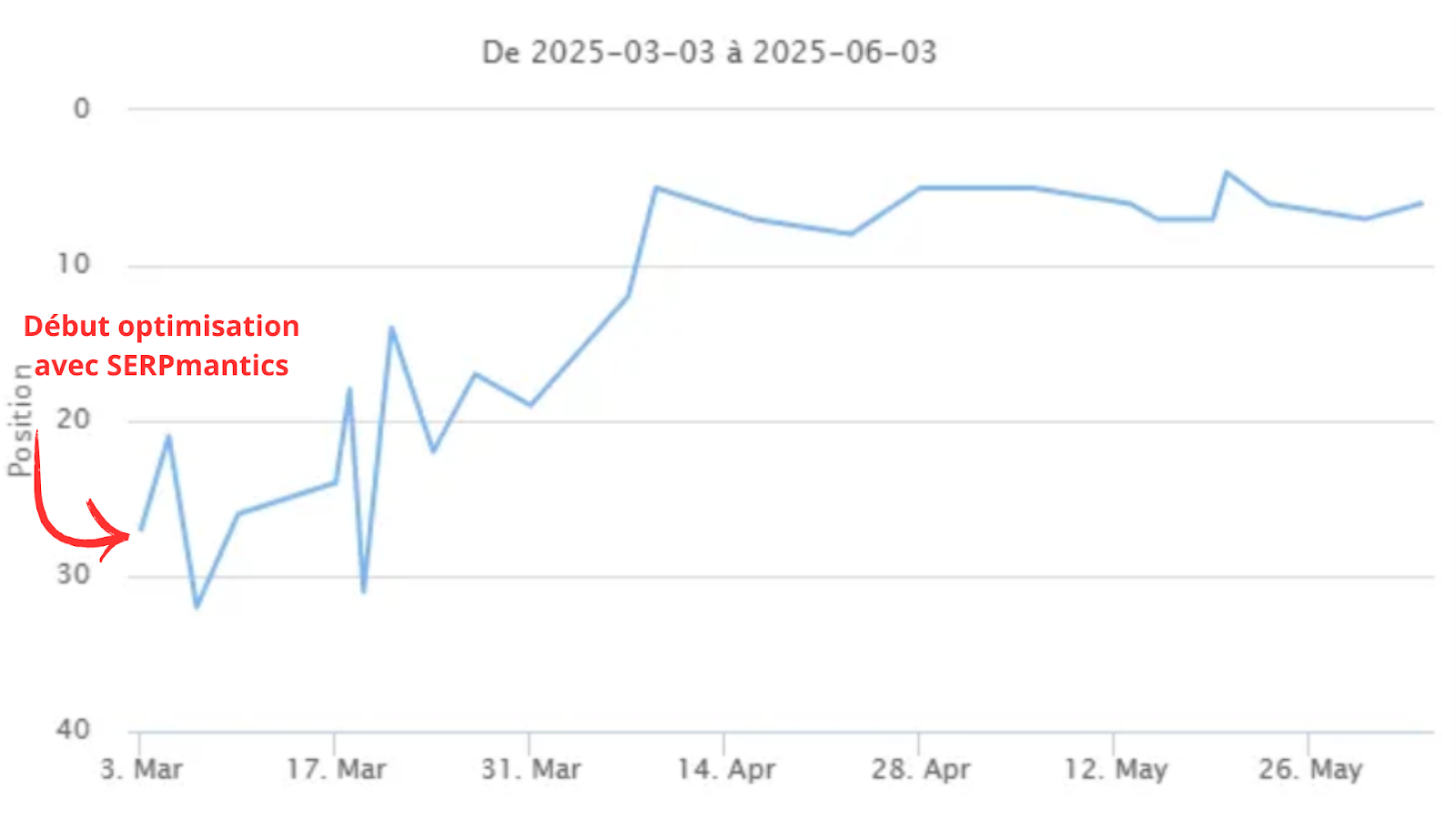
+21 positions in 3 months
Case 2: Site enhancement in the travel sector
The second case is part of a test carried out in-house by Linksgarden employees on several sites in the travel sector. The site Emmanuel had to optimize was initially positioned very low, around the 100th positionwhich made it almost invisible in search results.
The aim was to test SERPmantics in a context where the content had already been written, but was probably under-optimized from a semantic point of view. After applying the SERPmantics recommendations, the site made a spectacular ascent in the SERPs: he climbed from 100th to 7th position, then reached the top 3 after a few more adjustments.
This case highlighted several factors: the semantic relevance of content, alignment with search intentions, and the quality of optimizations guided by SERPmantics.
From position 100 to top 10 in SERPs
Case 3: Other examples from the Linksgarden team
Thanks to optimization via SERPmantics, a recent legal article published on a small site went from from 100th to 36th position in just 15 days (best position: 33), despite competition from 0.68 on Semrush.
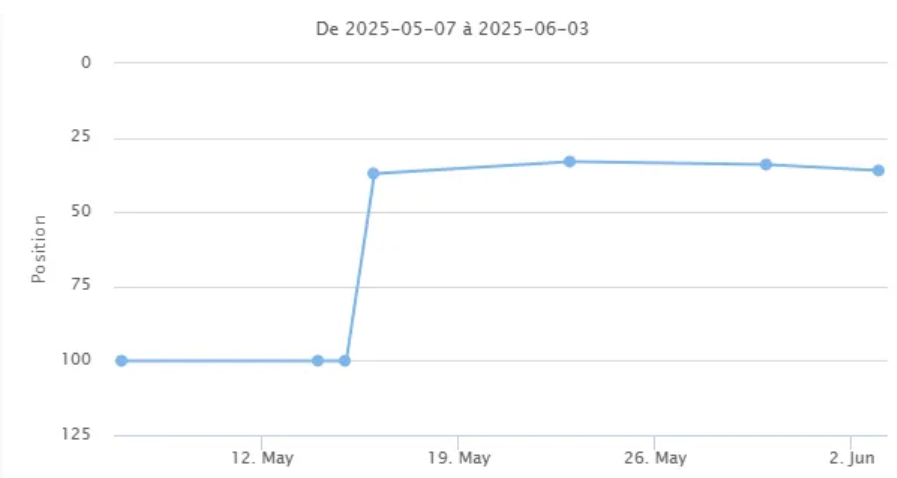
From 100th to 36th position in 15 days with SERPmantics
A blog post based on a keyword in the hunting theme, published on a generalist site with no competition (0 on Semrush), has been rewritten and optimized using SERPmantics.
On this highly unstable SERP, where results often change, the content rewriting with the help of optimal plan proposed by SERPmantics enabled clearly stabilize positions over time.
Even if position gains vary according to the level of optimization, keywords reworked with SERPmantics show much greater stability. What's more, fewer fluctuations are observed.
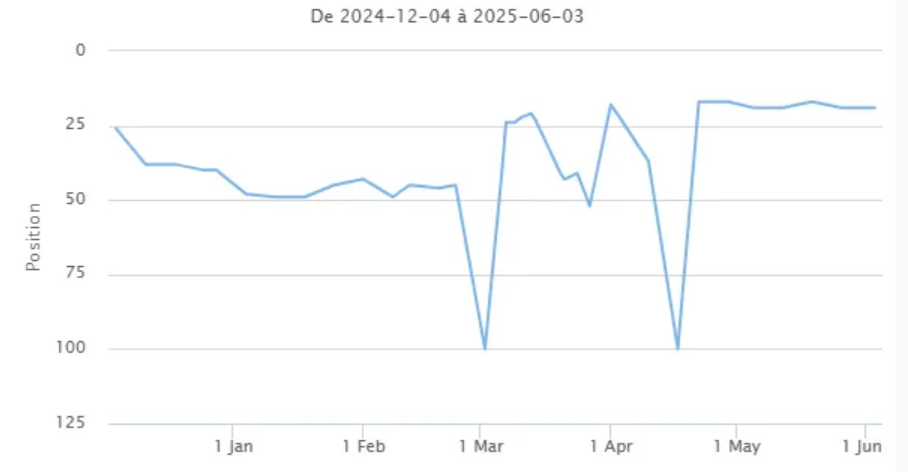
The specific benefits of SERPmantics
Intuitive interface for beginners
One of the first assets put forward by Emmanuel and his team concerns SERPmantics' clear, ergonomic interface. Unlike some competing tools, which require considerable adaptation time, SERPmantics offers a seamless experience for SEO professionals than for beginners.
"It can suit beginners, those with zero knowledge for example. In fact, it's easy to get to grips with, it's intuitive."
Viewing recommendations is easy thanks to a color-coding system that identify at a glance which elements need to be reworked, which are already optimized and which could be improved. This makes optimization work easier to read, structured, fun and quick to usewithout having to go through a lengthy technical learning phase.
"I haven't re-tested other tools lately, but of the tools I've been able to test so far, they stand out, you see, in relation to the interface already and in performance."
Sharing the optimization guide
Among the most popular features differentiating from SERPmantics according to Emmanuel, not found in the other tools tested so far, there's the sharing the optimization guide via a collaborative link. This is a game-changing feature, as it allows customers to be directly involved in optimizing their content.
"Frankly, it [SERPmantics] stands out from the competition.
In practice, the customer receives a link that gives him access to clear optimization recommendationswithout the need to log in or take out a subscription. It can edit content directly in the tool, with a real-time view of the optimization score.
In addition to facilitating the direct involvement of the customer in the process, this mode of operation empowers them to edit their own content. For the agency, this represents a significant time savings and a smoother collaboration, particularly in cases where the customer wishes to retain control over its editorial line. It's also a good way to empower the customer, while keeping the control over the quality of proposed optimizations.
Integrating your site into the tool
SERPmantics allows users to connect all their sites to the toolThis provides an overview of existing pages, their SEO performance and optimization opportunities. Right from the initial analysis, the team can quickly identify high-potential pages and prioritize efforts.
This allows you to quickly identify priority pages, identify content to be reworkedand set up a clear action plan for overall site optimization. Emmanuel sees it as a real advantage to leave no stone unturned.
Analysis of search intent
SERPmantics doesn't just provide lists of keywords: it interprets the type of content expected by Google on a given query, as well as users' questions and objectives.
This feature allows Emmanuel to produce much more relevant content, for both search engines and Internet users. The "search intentions" feature helps identify topics missing from a page, to adjust the structure, and get as close as possible to the expectations expressed in the SERPs.
Optimum use strategy
Recommendations for new users
To take full advantage of SERPmanticsEmmanuel shares several recommendations from his day-to-day experience with the :
The first step is simple: write naturally. Before even thinking about optimization, he recommends producing raw, unrestricted content. This content will serve as an authentic base, written in a fluid language, as close as possible to the user's needs.
Next, SERPmantics acts as a guide. By following the recommendations provided by the tool (text length, keyword density, semantic enrichment, etc.), the page is gradually improved. while retaining control over tone and editorial line.
Finally, Emmanuel insists on one fundamental point: you must always quality over quantityand stay focused on search intent. It is this consistency between the content and the expectations of web users that guarantees sustainable SEO results.
Mistakes to avoid
Experience in the field has also enabled us to identify several mistakes to avoid when using SERPmantics, especially during the initial optimizations.
The first mistake is to drift into off-topic content. Emmanuel cites a telling example: a pizzeria that tells the story of pizza instead of highlighting its offerings. Even if the text is technically optimized, it doesn't meet the real search intent.
Also, some users aim for the highest score at all costs, following the recommendations in a mechanical way, with no fluidity in the text. The aim is not to force the text to correspond to a score, but to use it to refine what has already been written and find a new way to express it. balance between fluidity and SEO performance.
Finally, produce content that is too long without real added value is counter-productive. It's not enough to flesh out a text for it to perform. Every addition must be relevant, structured and, above all, useful for the user.
Conclusion
Emmanuel's experience with SERPmantics highlights the concrete strengths of the tool, both from the point of view of an SEO agency and a website publisher. What stands out first and foremost are tool accessibility Whether you're a beginner or an expert, you'll quickly get the hang of it thanks to a clear, intuitive interface.
But beyond its simplicity, SERPmantics is a efficient tool. It centralizes in a single space the essential functions of quality SEO content. Not only can content be precisely optimized, but customers can be directly involved in the process at no extra cost.
By integrating analysis of search intent, SERPmantics goes further than simple semantic analysis tools: it helps you produce content that's truly semantic. aligned with what web users are looking forwhich translates into visible improvements in Google rankings.
The impact of SERPmantics on the SEO performance observed within Linksgarden and on Emmanuel's own sites speaks for itself. In handing over the optimized content at the heart of SEO strategythe tool has enabled improve positions a wide range of content in search results, and thus make them more visible. What's more, it enables them to guarantee the effectiveness of backlink campaigns, which are supposed to work only with quality content. If he had to convince a colleague to use SERPmantics in one sentence, here's what he'd say: "Look at my before and after positions."
Emmanuel says to himself fully satisfied with SERPmantics tool. He stresses an important point: netlinking alone is not enough. Without quality, optimized and relevant content, you risk waste both budget and SEO potential. For him, good positioning always starts with content. aligned with users' search intentAnd this is precisely where SERPmantics makes all the difference.
 English
  French
  German
  Spanish
  Italian
  Portuguese
  Polish
  Turkish
  Dutch
Dutch  Czech
Czech  Danish